
8 Chapter Eight: Mythical Flora and Fauna

Flora as Symbols 

“The land holds memories within it. This is a challenging idea to us now but it was pervasive in ancient thought. It is essentially an articulation of the soul of place” (Magan 152).


Read the Introduction to Niall Mac Coitir’s Ireland’sTrees – Myths, Legends & Folklore. The Collins Press, 2003. EBSCOhost, https://search-ebscohost-com.libproxy.txstate.edu/login.aspx?direct=true&db=nlebk&AN=1008311&site=eds-live&scope=site.


“Sweeney’s Lay” by Mad Sweeney, 7th century


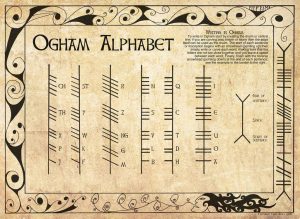
Ogham: B = Beit = Birch | F = Fearn = Elder | S = Sail = Sallow | Duir = Oak | C = Coll = Hazel | Onn = Ash


Original (Noble) trees of Ireland:

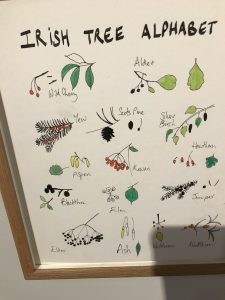
Rowan, Ash, Willow, Oak, Hazel, Birch, and Scot’s Pine


Rowan
Rowan


Hurley and Sliotar
Hurley & Sliotar: Clash of the Ash


Oak Tree
Oak Tree


The Irish Yew - Taxus Baccata Fastigiata - Scotland's Yew ...
Yew

“Yew trees are best known for their association with graveyards where they are widely found” (Mac Coitir 139).  There are yew trees near the Tailor and Ansty’s graves in Gougane Barra.


Holy Trees/Wells

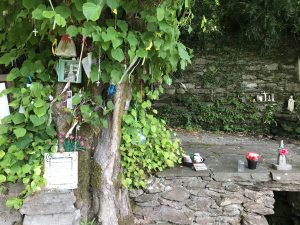
“there are more than 3,000 holy wells in Ireland dedicated to saints, and the majority have a tree or bush beside them. . . . Of a survey of 210 wells throughout the country, Lucas found of the trees beside them, 103 were hawthorn, 75 were ash, and the rest were randomly distributed among various species” (Mac Coitir 9).

Mac Coitir, NIALL. Ireland’s Trees – Myths, Legends & Folklore. The Collins Press, 2003. EBSCOhost, research.ebsco.com/plink/0dd5e205-befa-30c3-8505-e63432a71f98.
St. Gobnait's Well & Tree
St. Gobnait’s Well & Tree


Weave rushes for St. Brigid’s Day/Imbolc (i.e. St. Brigid’s cross)
St. Brigid's Cross
St. Brigid’s Cross
Making St. Brigid's Crosses
Making St. Brigid’s Crosses


St. Brigid's Cross
St. Brigid’s Cross

Tansy

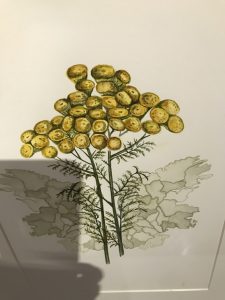
"Tansy" by Jennifer Trouton, Mater Natura: The Abortionist's Garden
“Tansy” by Jennifer Trouton, Mater Natura: The Abortionist’s Garden

Bellanabriscaun -> Beal Atha na mBrioscan “the settlement of the ford of the wild tansy.” “A place like Bellanabriscaun would have received more covert night visits by women in distress, as tansy has long been used to induce miscarriages when taken in high doses” (Magan 140).


Foxgloves

Foxglove
Foxglove

Digitalis was proposed as the Latinised name for the plant in the 16th century by a German botanist, Leonard Fuchs (1501–66). Fuchs is German for ‘fox’. Apparently, he chose digitalis, a Latin way of saying ‘pertaining to the finger’, because the common German name for the plant is Fingerhut, which means, literally, ‘a finger hat’ or thimble’.” I much prefer the explanation offered by Davies and Hollman—the fairies gave the flowers to foxes to wear on their feet so they could move in magic silence towards hens or away from men.” -TSUNG O CHENG Professor of Medicine, Division of Cardiology, The George Washington University Medical Center, 2150 Pennsylvania Avenue NW, Washington, DC 20037, USA


Fauna as Symbols  

The Wren

wren
A wren

Why, of all birds, is the inoffensive little wren chosen as the martyr for display by groups who take their name from it? Because of its treachery, some claim! It ‘betrayed St. Stephen, the first Christian martyr,, by flapping its wings to attract his pursuers when he was hiding’.

More say the hostility towards this most harmless of creatures results from the efforts of clerics in the middle ages to undermine vestiges of druidic reverence and practices regarding the bird. Medieval texts interpret the etymology of wren, the Irish for which is dreolín, as derived from ‘dreán’ or ‘draoi éan’ the translation of which is ‘druid bird.’

Wrenboys still go out in Ireland on St. Stephens Day (English Boxing Day). The central theme of the wrenboy visit is the wren, an effigy of which is carried about in a holly branch or in a box or cage. Previously it was hunted and killed prior to St. Stephen’s Day and a matter of honour for groups to have a real bird. Source: https://www.sligoheritage.com/archwrenboys.htm


The Garryduff Wren: https://archaeologyireland.ie/2018/03/02/the-garryduff-gold-bird/

Garryduff Bird
Garryduff Bird (Wren) on display at the City Museum in Cork City


One of the most interesting legends involving a wren is that Cliodhna, a woman of the otherworld, seduced young men to follow her to the seashore. Here they drowned in the ocean into which she enticed them. Eventually a charm was discovered that not only protected against her wiles, but could also bring about her destruction. Her only method of escape was to turn herself into a wren. As a punishment for her crimes she was forced to take the shape of the little bird on every succeeding Christmas Day and fated to die by human hand. Hence the seemingly barbarous practice of hunting the wren.

“Cliodhna was drowned while hiding in the form of a wren to escape her progenitor, the principal sea god Mannanan, who wanted to do one of three things depending on which version you hear: take back her power, limit her freedom or crush the love she had for a young human, Ciabhan of the Curling Locks” (Magan 82).

Cliodhna
Cliodhna Mural in Cork City

The Hooded Crow

A hooded crow
A hooded crow
  • “When a native speaker uses the word badhbh for a hooded crow, there is in the word the memory of its earlier homonym, which refers to a female fairy who appears in phantom bird form to certain families” (Magan 110).
  • The word badb is a generic term, signifying supernatural women, sometimes in the form of crows, who hover over the battlefield, foretelling the slaughter and later feeding on the slain” (Clark 225). In The Tain, Nemain and the Badb call out to the men of Ireland and a hundred warriors die of fright” (228). “A connection between Badb and the banshee seems likely; both are female spirits who prophesy death and destruction and terrify people with their fearsome howls” (226).
  • In Irish mythology, the goddess Badb features in the story of Táin Bó Cúailnge, taking on the form of a crow or raven as she causes terror amongst the forces of Queen Medb.

The Owl & CORMORANT

An owl
An owl


The owl is sometimes referred to as cailleach oiche (‘the night witch’) and the cormorant sometimes called the cailleach dhubh (‘the black hag’)” (Magan 233).

Cormorants
Cormorants

Cranes

A crane
Common crane
  • Cranes were “believed by druids to carry the soul from one incarnation to the next. . . . They are depicted in the Book of Kells, and one is carved into an eight-century high cross in Co. Tipperary. . . . Their single open eye could stare directly into the Otherworld and . . . by standing on one leg, they could shift between worlds without being fully present in either. . . . Aife was transformed into a crane by a spurned lover. Late the sea god Mannan used her skin to make a crane bag to carry his most valuable treasures” (Magan 307-08).


Cranes on a manhole cover - Western Road, Cork City
Cranes on a manhole cover – Western Road, Cork City


Swans

A swan
A Mute Swan and cygnets


  • The children of Lir become swans when their stepmother Aoife becomes jealous of their father’s love for them.
Children of Lir
Sculpture of the Children of Lir in Dublin


The eel is a symbol of the Celtic Otherworld (Tír na nÓg) deity/Formorian King Balar or Aedh.

Relevant to Sean O’Faolain’s “The Silence of the Valley”


Salmon

Salmon
Salmon

When the Flood comes, Fintán is the only one to survive. He becomes a salmon and later an eagle and a hawk, living for 5,500 years after the Flood, whence he becomes a man again and recounts Ireland’s history.


The “Salmon of Knowledge” (Bradán Feasa) is a famous Irish legend. It recounts how a druid and poet named Finnegas spent years trying to catch the magical fish, which gained the wisdom of the world by eating hazelnuts from the Well of Wisdom. When Finnegas asks Fionn Maccumhail (Finn McCool) to cook the Salmon of Knowledge, Fionn accidentally burns his finger. When Fionn sticks his burned finger in his mouth, HE acquires the wisdom.

Salmon and Heron Mural

Seals

Seals
A seal

Selkies are mythological creatures that can shapeshift between seal and human forms by removing or putting on their seal skin.

Song of the Sea
Song of the Sea

Deer/Fawn

Oisin
Oisin

Fionn McCumhaill: “We have caught something on this hunt,” said he to Caelte mac Ronan. “We must bring this treasure home. You shall be one of the Fianna-Finn, my darling,” he called upwards. The boy looked down on him, and in the noble trust and fearlessness of that regard Fionn’s heart melted away. “My little fawn!” he said. And he remembered that other fawn. He set the boy between his knees and stared at him earnestly and long. “There is surely the same look,” he said to his wakening heart; “that is the very eye of Saeve [Oisin’s mother].”


Hares

A hare
A hare

The hare was a sacred and mystical animal to  the Celts; a symbol of abundance, prosperity and good fortune. They were believed to have  connections to the Otherworld. They were treated with great respect and never eaten. A group of hares is called a drove, a down or a husk and they are well known for their boxing antics around the mating season in March.  Celtic myths and legends often told of shapeshifting hares who could transform into human form. The great warrior, Oisin was said to have wounded a hare in the leg while out hunting one day. The hare fled into the undergrowth and Oisin followed only to find a woman inside with a cut on her leg.


BEES

St. Gobnait
St. Gobnait, Ballyvourney


St. Gobnait (Honan Chapel)
St. Gobnait, Honan Chapel & Kinsale Mead

Legend holds that St. Gobnait established an abbey in Ballyvourney, County Cork, in the 6th century. She miraculously turned her beehives into a buzzing army to drive away thieves and marauding chieftains.


cows/bulls

Finnbhennach and Donn Cuailnge from The Tain

There are many Irish names for Cows:

Stuacín: a cow with upturned horns

Cubach: a cow with bent-in horns

Droimeann: a white-backed cow

Braobaire: a reckless cow (or a rude person)

Ceannann: a white-faced cow (or a star-shaped blaze on an animal’s forehead

Ceart-Aos: a two-year-old heifer

Colann: a yearling cow

Cnámharlach Mairte: a bony, withered cow

Bléineach: a white-loined cow

Bradaí: a thieving or wandering cow (or person)

Boinín: a little cow

Bleachtach: a milch cow

Loílíoch: a cow after calving

Maoilín: a hornless cow

Raspa: a bony old cow

Bó Thórmaigh: a cow about to give birth

Spangaire: a barren cow

Bearach: a young heifer

Liath: a grey cow

Bodógh: a young heifer

Source:  Tree Dogs, Banshee Fingers and Other Irish Words for Nature by Manchán Magan

License

Icon for the Creative Commons Attribution 4.0 International License

Irish Myth Copyright © by Nancy Effinger Wilson is licensed under a Creative Commons Attribution 4.0 International License, except where otherwise noted.